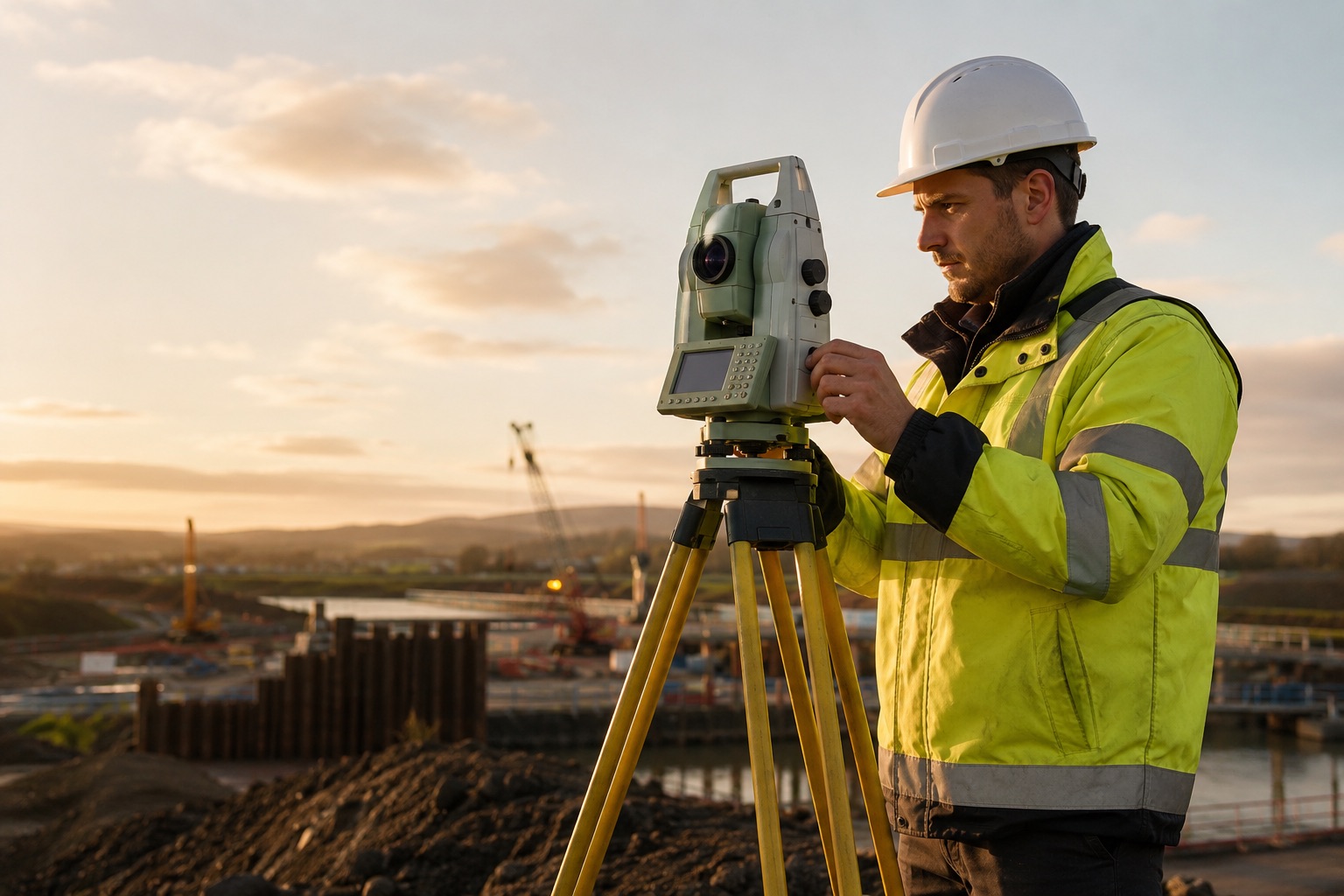
Every survey is a foundation. The topographic model a drainage engineer designs from, the measured building survey an architect overlays a refurbishment onto, the point cloud a structural engineer assesses a bridge from — every decision downstream inherits whatever quality, or whatever error, was baked into that first dataset.
Choosing who produces that data is one of the most consequential early decisions on any project. Yet it is often made on price alone, with little scrutiny of whether the firm is actually qualified to do the work. This article sets out what professional accreditation means in the UK survey industry, and the specific, practical risks of appointing a firm that holds none of it.
The industry itself has started saying so publicly. Through October 2026 the geospatial trade press reported a cross-industry push on standards, alongside open warnings that price-led procurement is driving a race to the bottom in survey quality — buyers appointing on day rate alone, receiving data with no stated accuracy band and no verification evidence, and discovering the shortfall only when a design built on it fails to fit. Regulation is the practical defence against that: a RICS-regulated practice is accountable for the standard it states, and the standard is checkable before appointment.
What RICS regulation actually means
“Surveyor” is not a protected title in the UK. Anyone can buy a drone or a total station, build a website and start trading. RICS regulation is what separates a genuinely accountable practice from an unaccountable one — and it is the single source of truth for whether a firm is qualified.
RICS — Royal Institution of Chartered Surveyors
RICS is the gold standard in surveying. The global professional body, operating under Royal Charter since 1881, RICS sets the benchmark against which every other credential is measured — and no other accreditation carries the same weight. A firm that is RICS-regulated is bound by obligations that an unregulated firm simply is not:
- It must comply with the RICS Rules of Conduct and mandatory professional standards.
- It must carry professional indemnity insurance to defined minimum levels.
- It must operate a formal complaints-handling procedure with access to an independent redress scheme.
- It is subject to RICS monitoring and disciplinary powers — including the ability to investigate, sanction and ultimately remove a firm.
When you appoint a RICS-regulated firm, you are not just buying a survey. You are buying enforceable accountability.
Professional indemnity insurance
PII is what stands behind the firm if its data is wrong and that error causes you a financial loss. A RICS-regulated firm must carry it. An unregulated firm may carry none, may carry a token amount, or may hold a policy that excludes the very survey type you have commissioned. Without it, a survey error is your loss to absorb.
How to check a firm yourself
You do not have to take a firm’s word for it. RICS maintains a free public directory of every RICS-regulated firm at ricsfirms.com. If a firm tells you it is RICS-regulated, you can confirm it there in seconds. If it is not listed, that tells you everything you need to know — before you appoint, not after.
The risks of using an unaccredited firm
1. If the data is wrong, you may have no recourse
Survey errors compound. A topographic survey that is out by 100 mm leads to drainage that will not fall correctly, foundations set at the wrong level, and clashes that surface only on site. With a regulated, insured firm there is a clear route to recovering that cost. With an unaccredited firm, you may be left to absorb the rework, the delay and the consequential losses yourself.
2. No independent redress
If a dispute arises with a RICS-regulated firm, you have access to an independent redress process. With an unregulated firm your only route is the courts — slow, expensive, and worthless if the firm has no assets or insurance behind it.
3. Unverified accuracy and no quality assurance
Chartered firms work to defined standards — the RICS measured survey specifications, the RICS Code of Measuring Practice, recognised accuracy classes. An unaccredited firm is accountable to no standard at all. “It looked about right” is not a quality system, and you will not discover the difference until the data fails downstream.
4. Deliverables that will not be accepted
Survey data frequently has to satisfy a third party — the Planning Inspectorate for a DCO or EIA, HM Land Registry for a boundary determination, a lender, an insurer, or a framework auditor. Many of these bodies expect, or require, the involvement of a chartered professional. Data from an unqualified firm risks being rejected outright — after you have paid for it and built your programme around it.
5. Health and safety exposure on your site
Professional survey firms mobilise with site-specific risk assessments and method statements, confined-space and working-at-height competence, and the right insurance. An unaccredited firm may have none of this. Under UK health-and-safety law, an accident involving an incompetent contractor on your site does not stay neatly with that contractor — it becomes your problem too.
6. Survey evidence that will not stand up in a dispute
In a boundary dispute, a party-wall matter or a dilapidations claim, survey evidence is only as strong as the professional standing of whoever produced it. Courts, the Land Registry and opposing experts give far greater weight to a chartered surveyor. A survey from an unqualified firm can be challenged — and dismissed — on credentials alone.
7. No continuity, no accountability
An unregulated, uninsured firm can simply disappear. Two years later, when a defect emerges and you need the original survey defended or re-issued, there is no firm, no record and no insurer to turn to. Chartered practices carry continuity and record-keeping obligations precisely so that the work remains accountable long after handover.
What to check before you appoint a survey firm
A short, practical checklist:
- Is the firm RICS-regulated? This is the single thing that matters most — check it yourself at ricsfirms.com, RICS’s free directory of regulated firms.
- Are the individuals chartered? Look for MRICS or FRICS.
- Ask to see the professional indemnity insurance certificate — and check the level of cover and that it covers your survey type.
- Ask which standards the deliverables will be produced to — a credible firm will answer immediately.
- Be wary of a quote that is far below the others. It usually means corners — uninsured, unaccredited, or unqualified — that you will pay for later.
The bottom line
The cost of a survey is a small fraction of the cost of the project that depends on it. Appointing an unaccredited firm to save a few hundred pounds can expose you to rework, rejected submissions, uninsured liability and survey evidence that collapses under scrutiny — costs that dwarf any saving.
A qualified, RICS-regulated firm is not simply a more expensive option. It is a transfer of risk away from you: enforceable standards, real insurance, independent redress and lasting accountability. RICS is the gold standard for a reason — on a project where everything downstream rests on the survey, regulation by the profession’s benchmark body is not a luxury, it is the entire point.
Angell Surveys is an RICS-regulated practice with chartered surveying expertise. If you would like to discuss a project, get in touch.