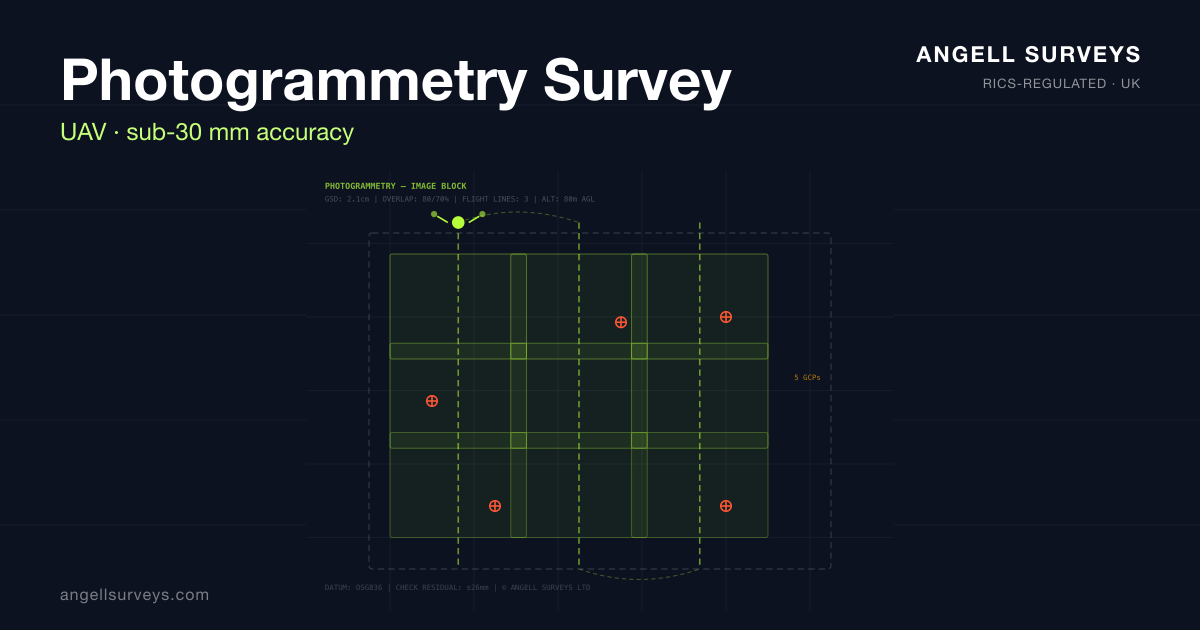
Drone photogrammetry is the workflow that turns hundreds of overlapping aerial photographs into a survey-grade 3D model of a site. Done well, with a properly designed Ground Control Point (GCP) network and the right sensor, it produces results at RICS Band D or E accuracy (±10–25 mm at 1σ on hard detail) — accurate enough for topographic mapping, earthworks volume calculations, façade modelling, and most civil-engineering BIM workflows.
Done badly — flown without GCPs, processed with default settings, delivered as a coloured point cloud with no accuracy statement — it produces a pretty image that’s metres off the true position. This guide walks through what separates the two, and the decisions that determine which you get. If you need a survey delivered, see our drone photogrammetry survey service.
How modern UAV photogrammetry works
The technique is built on Structure from Motion (SfM) — a computer-vision algorithm that figures out the camera’s position and orientation for each photo by matching common features across overlapping images. The output is a sparse point cloud (the matched feature points), then a dense point cloud (a denser interpolation), then a textured mesh, then an orthomosaic and a Digital Surface Model. Modern processing software (Agisoft Metashape, Pix4DMatic, Bentley ContextCapture, RealityCapture) automates the pipeline.
The accuracy of the final model depends on five things:
- Image quality — sensor size, lens quality, image sharpness, exposure consistency
- Image overlap — 70–80% forward overlap, 60–70% side overlap is typical
- Flight planning — altitude, ground sample distance (GSD), boustrophedon (lawnmower) pattern with sufficient cross-strips
- GCP network — number, distribution, and surveyed accuracy of ground control
- Processing settings — bundle adjustment quality, depth-map resolution, mesh decimation
Of these, the GCP network is the dominant factor. A perfect image set processed without ground control will drift several metres in absolute position; the same image set with a well-distributed GCP network resolves to RICS Band D/E (±10–25 mm at 1σ).
Sensor selection
Two airframe classes are in common use for survey-grade UAV photogrammetry — fixed-wing VTOL for large areas and corridor, multirotor for small or constrained sites:
| Airframe | Typical payload | Resolution | Best for |
|---|---|---|---|
| Fixed-wing VTOL — WingtraRAY | Mechanical-shutter full-frame, 42 / 61 MP | 42–61 MP | Large-area topographic, corridor, NSIP / DCO sites |
| Multirotor | Mechanical-shutter full-frame, ~45 MP class | 20–45 MP | Small or access-constrained sites |
| Heavy-lift multirotor | Medium-format custom payload, 100 MP+ | 100 MP+ | Heritage façade, ultra-detail capture |
Angell Surveys operates the WingtraRAY as the primary photogrammetric platform. Its VTOL configuration takes off and lands vertically like a multirotor but cruises as a fixed-wing — covering roughly 4–15 km² in a single flight at survey-grade GSDs (depending on altitude, payload and overlap) with the access flexibility of a multirotor. Combined with on-board PPK and a mechanical-shutter sensor, it produces survey-grade imagery suitable for RICS Band D/E hard-detail accuracy (±10–25 mm at 1σ) across large sites in a single mobilisation.
Crucially, photogrammetry needs a mechanical-shutter sensor for survey-grade work. Rolling-shutter sensors distort moving features (and a moving aircraft is “moving” for the purposes of every photo), introducing position errors that no amount of GCP work can fix.
Ground Control Points — the accuracy engine
A GCP is a precisely surveyed point, visible from the air, distributed across the site. Each GCP gets a known XYZ coordinate (from RTK GNSS or total station) and the processing software uses them to constrain the photogrammetric solution.
A useful GCP network looks like this:
- 5 minimum for a small site (under 5 ha) — one near each corner plus one in the centre
- 8–12 for a medium site (5–25 ha) — distributed on a grid with extras at elevation extremes
- One every 100–200 m along a linear corridor (highway, rail, pipeline)
- At least 2 independent check points — surveyed identically to the GCPs but withheld from the bundle adjustment, used to verify accuracy independently
The check-point residuals tell you the true accuracy of the model. If the GCPs were the only measure, you’d just be confirming the software was internally consistent — you wouldn’t have a measure of error. Independent check points are the difference between a claimed RICS Band D/E result and a verified RICS Band D/E result.
Ground markers are usually 600 mm × 600 mm chequer-board targets, painted or fabricated, laid out before flight and recovered after. On stable hard surfaces (paving, road) the target is sometimes painted directly. On corridor work where access to the corridor is restricted, the GCP network is established during a possession or a single brief access window.
Accuracy budget
A well-executed UAV photogrammetric survey produces these typical accuracies on hard detail (paved surfaces, kerb edges, structural elements), mapped against the RICS Measured Surveys of Land, Buildings and Utilities (3rd edition) accuracy bands every Angell Surveys deliverable references:
| Output | Typical accuracy (1σ) | RICS Band |
|---|---|---|
| Plan position (X,Y) | ±10–25 mm | D or E |
| Elevation (Z, hard detail) | ±10–25 mm | D or E |
| Volume (stockpile) | ±2–4% by volume | (derived) |
| Orthomosaic GSD | 1.5–3 cm per pixel | — |
Which band is achieved on any given project depends on flight planning (altitude, overlap, GSD), the GCP network density and accuracy, the target surface (hard vs soft detail), and the contractor’s tolerance specification. The deliverable always reports the actual measured residuals against the independent check points, not just the theoretical band.
On soft cover (long grass, dense vegetation, water surface) accuracy degrades sharply — photogrammetry sees the surface canopy, not the ground beneath. For ground levels under vegetation, LiDAR is the right tool (covered below).
When LiDAR is the better choice
Photogrammetry and LiDAR are complementary, not competitive. The right tool depends on the use case:
| Factor | Photogrammetry | LiDAR |
|---|---|---|
| Bare-earth under vegetation | Cannot see through | Excellent (multi-return) |
| Texture / orthomosaic | Excellent | Limited (intensity only) |
| Hard-detail accuracy | RICS Band D/E with GCPs | RICS Band D/E |
| Capture in low light / overcast | Limited (needs daylight) | Independent of ambient light |
| Vertical surface (façades) | Excellent if flown obliquely | Good |
| Point cloud density | Very high (millions/m²) | High (~hundreds/m²) |
| Cost per hectare | Lower | Higher (sensor £40k+) |
Decision rule of thumb: if you need bare-earth under tree canopy or dense undergrowth, choose LiDAR. If you need a high-resolution textured orthomosaic and hard-detail accuracy, choose photogrammetry. If you need both, fly both — most large-area work pairs a WingtraRAY LiDAR flight with a WingtraRAY photogrammetric flight over the same envelope and merges the two datasets in processing.
See LiDAR vs photogrammetry for a deeper comparison.
Deliverables and formats
A standard photogrammetric deliverable includes:
- Orthomosaic (GeoTIFF) — corrected aerial image, georeferenced, at the agreed GSD
- Digital Surface Model (DSM) / Digital Terrain Model (DTM) as a raster or TIN
- Dense point cloud in LAS or LAZ format, classified at minimum into ground / non-ground
- 3D mesh in OBJ or FBX for visualisation and BIM coordination
- Contour plan (DWG) at the agreed contour interval
- Survey report — flight parameters, sensor used, GCP network, check-point residuals, processing software and version
All outputs are typically referenced to OSGB36 / Newlyn ODN unless the contractor has a defined site grid.
Typical applications
- Topographic surveys for civil engineering (highway, drainage, earthworks) — see our 70 km² Anglian Water reservoir DCO case study for an example of fixed-wing photogrammetry at NSIP scale
- Volumetric monitoring of stockpiles, landfill cells, quarry benches — see our drone mining survey guide
- Construction progress monitoring — repeat surveys at agreed intervals with change detection. See our Critical National Infrastructure weekly earthworks monitoring programme for the volumetric workflow on 320–700 ha CNI sites with 24-hour cut-and-fill reporting.
- Façade modelling of heritage buildings — combined with terrestrial laser scanning for full coverage
- Solar farm pre-design — combined existing-ground + thermal post-construction
- Pipeline corridor mapping — typically alongside drone pipeline inspection for full asset characterisation
What to put in a brief
- Required absolute accuracy — typically “±30 mm plan, ±50 mm Z” for civil engineering work
- Ground Sample Distance (GSD) — for example “2 cm/pixel orthomosaic”
- Deliverable formats (GeoTIFF, LAS, DWG, OBJ — be specific)
- Reference system — OSGB36 / Newlyn ODN unless site grid required
- GCP and check-point requirements — how many independent check points
- Constraints — site access window, no-fly zones (CAA), adjacent restricted airspace, third-party flight permissions
Frequently asked questions
Do you need GCPs if you have an RTK drone? RTK drones (with corrections from a ground base station) improve the consistency of camera positions but do not eliminate the need for ground control. RTK alone typically achieves ±5 cm position accuracy on the camera — but the photogrammetric solution still benefits from ground control to verify and constrain absolute accuracy. For survey-grade work (RICS Band D/E or better), GCPs are still recommended.
How is accuracy reported? A reputable surveyor reports the RMS residual on the independent check points (held back from the bundle adjustment). This is the verified accuracy. The RMS residual on the GCPs themselves only confirms internal consistency.
Can you survey a small site (under 1 ha) with photogrammetry? Yes, but the per-hectare cost is higher because mobilisation and GCP setup dominate. For small sites, consider whether terrestrial methods (total station, GNSS rover) or TLS are more cost-effective.
Can you fly in light rain? No. Most survey drones are not water-resistant, and image quality degrades in poor light. Light overcast is acceptable; precipitation or strong shadows are not.
What’s the CAA position for commercial drone work? Commercial drone work in the UK requires the operator to hold a CAA-recognised Operational Authorisation (formerly PfCO). All our flights are conducted by qualified remote pilots under our own CAA OA, with mission-specific risk assessments and method statements provided on request.
For drone photogrammetry surveys across the UK with verified RICS Band D/E accuracy on hard detail, see our drone photogrammetry service. All work includes a designed GCP network, independent check-point verification, and a full survey report with the residuals against your accuracy specification.