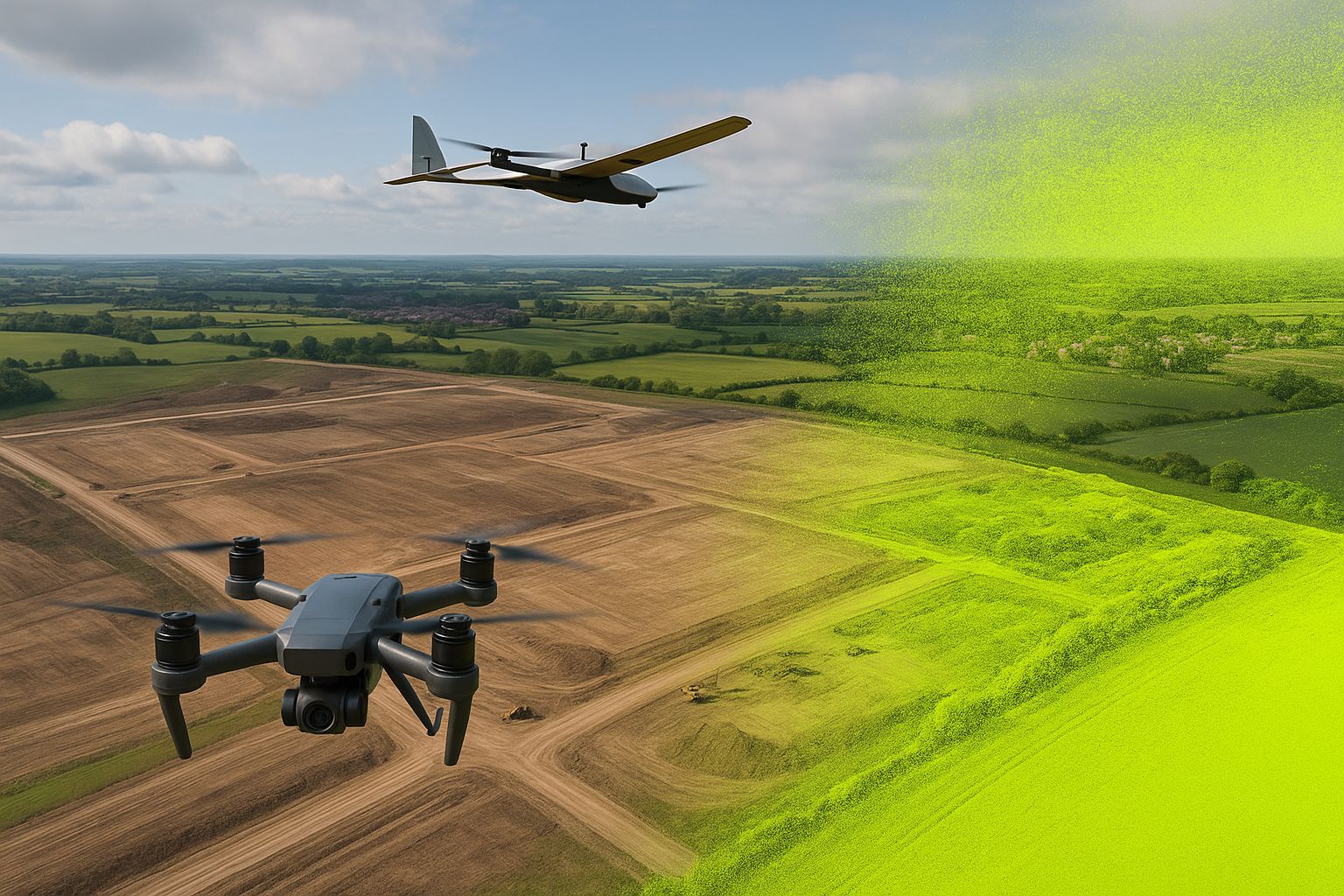
Fixed-wing or multirotor: when does each pay? A fixed-wing VTOL pays once the site is large or linear enough that coverage rate dominates the cost: multi-kilometre corridors, catchments and sites above roughly 20 hectares, where one sortie replaces many battery cycles. A multirotor pays on small, complex or access-constrained sites, and wherever the survey needs low, slow, angled capture around structures. Both reach RICS Band D or E with proper control (RICS, 2014).
| Site | Platform that pays | Why |
|---|---|---|
| Multi-kilometre corridor, reservoir, catchment or site above about 20 ha | Fixed-wing VTOL | Coverage rate; one sortie, stable geometry, BVLOS under Operational Authorisation where needed |
| Small plot, building elevations, street furniture, confined access | Multirotor | Hover, low altitude, oblique angles; minimal launch area |
| Weekly repeat capture of a large earthworks site | Fixed-wing VTOL | Consistent GSD and overlap between epochs inside a short site window |
The choice between a fixed-wing VTOL and a multirotor UAV for a survey is rarely a question of which aircraft is “better”. Both can carry a survey-grade mechanical-shutter sensor; both can achieve RICS Band D/E accuracy with a properly designed control network. The decision is almost entirely an economic one — driven by coverage rate, mobilisation overhead, and the resulting cost per hectare at the scale of your specific site.
This guide breaks down the economics of each platform class and identifies the crossover point where one decisively beats the other. If you need a survey delivered, see our drone photogrammetry service.
The two platform classes
Multirotor — a quadcopter or hexacopter that takes off vertically, hovers, and flies a programmed grid at low speed. Highly manoeuvrable, can fly close to vertical structures, can hold position. Endurance is typically 25–40 minutes per battery, and effective survey coverage is modest — a multirotor at 100 m AGL covers perhaps 20–40 hectares per flight at survey-grade overlap.
Fixed-wing VTOL — an aircraft that takes off and lands vertically like a multirotor but transitions to efficient forward flight on a wing for the survey itself. Angell Surveys operates the WingtraRAY in this class. It covers roughly 4–15 km² in a single flight at survey-grade ground sample distances — an order of magnitude more area than a multirotor for the same battery, because the wing generates lift far more efficiently than spinning rotors.
The cost drivers
Survey cost is dominated by time on site and office processing, not by the aircraft itself. The economic comparison comes down to four factors:
| Cost driver | Multirotor | Fixed-wing VTOL |
|---|---|---|
| Coverage per flight | 20–40 ha | 400–1,500 ha |
| Battery swaps for a 200 ha site | 6–10 | 1 (often part of one flight) |
| Mobilisation / setup | Low (small footprint) | Low (VTOL needs no runway) |
| Capture-geometry consistency | Variable on large sites | Excellent (one timestamp) |
| Processing volume | More images, more flights to stitch | Single contiguous block |
The decisive factor at scale is capture-geometry consistency. A 200-hectare site flown as eight separate multirotor sorties over two days introduces variation in altitude, lighting and overlap between blocks — which becomes systematic error when you difference surfaces for volumetric or change-detection work. A fixed-wing aircraft captures the whole site on a single timestamp with constant capture geometry, which is why all earthworks monitoring above ~20 ha is flown fixed-wing — see our CNI weekly earthworks monitoring case study.
The crossover point
As a rule of thumb for UK survey work:
- Under ~5 hectares — multirotor wins. Mobilisation and ground-control setup dominate at this scale; the fixed-wing’s coverage advantage never gets used, and the multirotor’s manoeuvrability is often needed for site constraints.
- 5–20 hectares — it depends on geometry. An open, regular site favours fixed-wing; a constrained or vertical-feature-heavy site favours multirotor.
- Above ~20 hectares — fixed-wing VTOL wins decisively. The per-hectare cost of a multirotor escalates with every additional battery swap and stitching block, while the fixed-wing simply flies a longer line.
At NSIP / DCO scale — 250 ha to 700 ha — there is no contest. A fixed-wing programme captures these sites in one or two flights where a multirotor would need days. See our 250 ha solar farm topographic case study.
Where multirotor remains essential
Coverage economics is not the whole story. A multirotor is the right — sometimes the only — tool when:
- Vertical structures need capture: building façades, bridge soffits, mast and tower inspection (a fixed-wing cannot hover or fly a vertical face)
- Thermal payloads are required: drone thermal surveys of solar arrays and building envelopes are flown on multirotors, not the Wingtra fleet — see our thermal imaging survey service
- Confined or obstructed sites: tight urban plots, sites bounded by tall obstacles, or anywhere a fixed-wing launch/transition footprint won’t fit
- Spot detail is needed at a handful of locations rather than area coverage
Most real-world engagements use the right tool per task — and many use both: a fixed-wing flight for area coverage plus a multirotor for the vertical faces and detail.
What this means for procurement
When commissioning a survey, the most cost-effective brief does not specify the aircraft — it specifies the deliverable, the accuracy band, and the site extent, and lets the surveyor select the platform that delivers it most economically. A brief that mandates “multirotor capture” on a 300-hectare site is paying for days of unnecessary flying; a brief that mandates “fixed-wing” on a building façade is asking for something physically impossible.
The right brief reads: “Topographic survey to RICS Band D, [extent] hectares, deliverables [DTM / orthomosaic / contours], referenced to OSGB36 / Newlyn ODN, accuracy reported against independent check points.” The platform choice then follows from the economics.
Frequently asked questions
Is fixed-wing always cheaper for large sites? For open-area topographic capture above ~20 ha, almost always — the coverage rate compounds in its favour. The exception is a large site dominated by vertical structures or one that requires thermal capture, where multirotor work is unavoidable regardless of area.
Does fixed-wing sacrifice accuracy for coverage? No. A fixed-wing VTOL carrying a mechanical-shutter full-frame sensor with PPK and a proper GCP network achieves the same RICS Band D/E accuracy as a multirotor. Coverage and accuracy are independent — accuracy comes from the sensor, the control network and the processing, not the airframe.
Why does capture geometry matter so much for monitoring? When you difference two surfaces to compute a volume or detect change, any variation in capture geometry between epochs introduces systematic error into the result. A fixed-wing captures the whole site in one consistent pass, which is why it is preferred for repeat monitoring programmes.
Can you fly fixed-wing on a constrained site? A VTOL fixed-wing needs only a small launch/landing pad, but it does need clear airspace to transition into and out of forward flight. On heavily obstructed sites the transition envelope may not be available, in which case multirotor capture is used.
For UAV survey work across the UK — fixed-wing VTOL for area and corridor, multirotor for vertical and constrained sites — see our drone photogrammetry service and aerial survey service. We select the platform to match your accuracy specification and site, and report accuracy against measured check-point residuals on every deliverable.