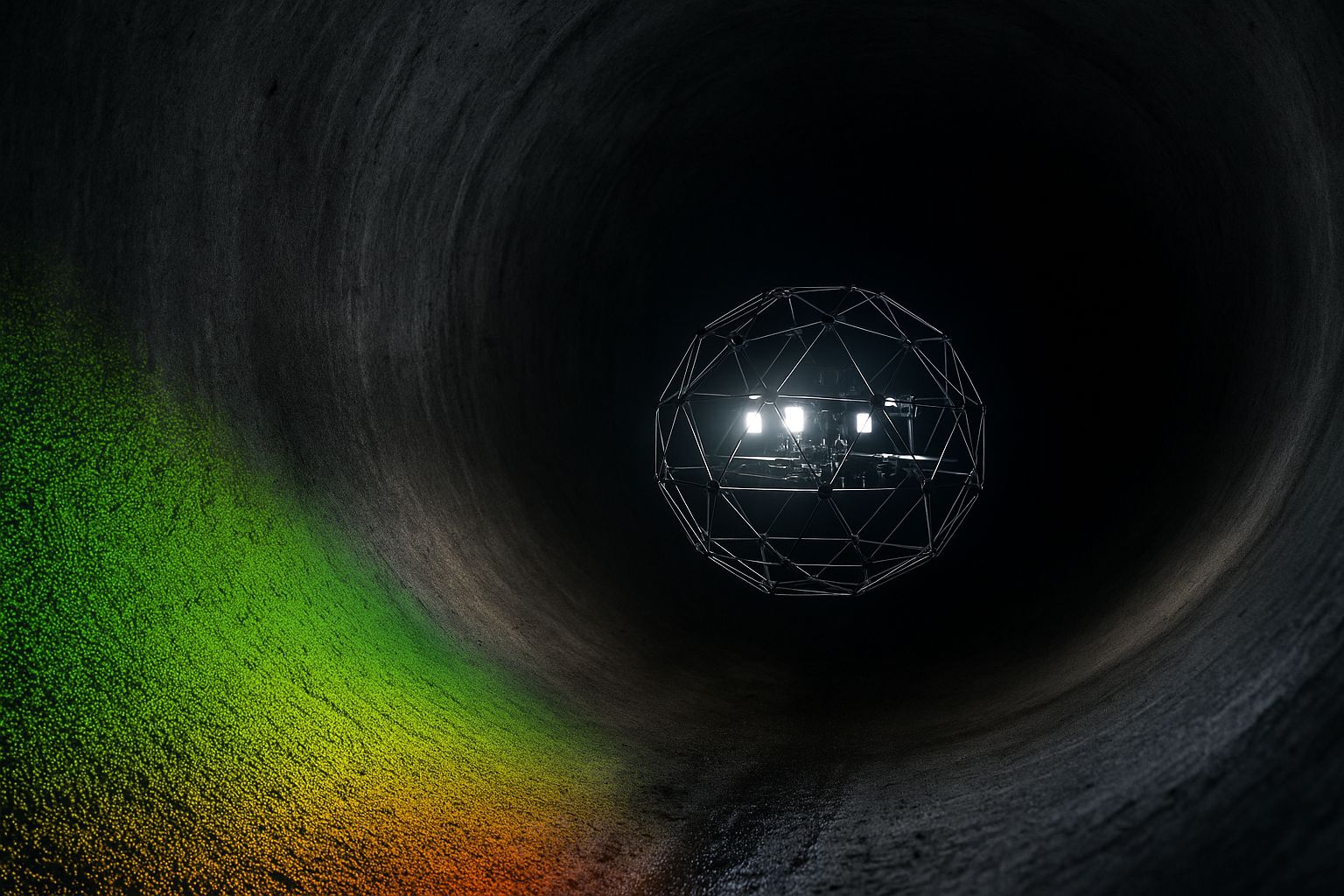
Tanks, pressure vessels, deep shafts, sewers, ducts, screen chambers and structural voids are among the most dangerous places a surveyor or inspector can go. Confined-space entry means atmosphere testing, a permit, a standby rescue team, gas monitoring and significant cost — every time. Collision-tolerant UAVs change that calculation: they let you inspect the inside of an enclosed structure without anyone going in at all.
This guide explains how Elios-class drones work, when each platform is the right one, and what they deliver. If you need an inspection delivered, see our confined space drone inspection service.
What a collision-tolerant drone is
A normal drone crashes when it hits something. A collision-tolerant drone is built to touch walls, pipes and obstructions and keep flying — its rotors sit inside a protective cage that lets the operator fly hard up against surfaces, into corners and through restrictions without losing control. That is what makes indoor, enclosed-space flight possible: in a tank or a shaft there is no margin for a crash, and the cage provides it.
Angell Surveys operates the Flyability Elios platforms — the current-generation Elios 3 and the earlier Elios 2. Both carry 4K video and lighting; the Elios 3 adds an integrated SLAM-based LiDAR payload that builds a navigable 3D model of the inspected space as it flies.
Elios 2 vs Elios 3 — why we run both
The two platforms are not redundant — they cover different access geometries:
| Elios 3 | Elios 2 | |
|---|---|---|
| Generation | Current | Previous |
| Diameter envelope | Larger | ~100 mm smaller |
| Sensor payload | Higher-res, integrated SLAM LiDAR | 4K video, lighting |
| 3D mapping | Yes (LiDAR) | Visual |
| Best for | Large-diameter assets, where a 3D model is needed | Tighter openings the Elios 3 won’t fit through |
The decisive factor on older or non-standard infrastructure is often the access opening, not the sensor. The Elios 2’s roughly 100 mm smaller diameter lets it pass through restrictions, hatches and historic chamber openings that the Elios 3 simply cannot. On a survey of a varied estate, the choice of platform per asset is driven by what the access geometry allows — which is exactly why we keep both in the fleet rather than just the newest.
The use cases
Collision-tolerant UAV inspection applies anywhere manned entry is dangerous, expensive or impossible:
- Water and wastewater — deep manholes, sewers, screen chambers, wet wells, inverted siphons. See our Thames Water Chalfont St Peter case study: ten manholes at 12–42 m depth on a 675 mm trunk sewer, inspected without manned entry.
- Industrial vessels and tanks — storage tanks, process vessels, silos, digesters — internal condition without erecting access or entering a hazardous atmosphere.
- Power and nuclear — penstocks, ducts, voids, cells and shafts on generation and nuclear sites, keeping personnel out of controlled and hazardous areas.
- Built environment — structural voids, ventilation shafts, lift shafts, basement and culvert structures.
- Mining and quarrying — underground workings, ore passes, shafts, process plant.
The safety case
The strongest argument for Elios inspection is the one that does not appear on the deliverable: the confined-space entry that didn’t happen. Every internal inspection flown by drone is:
- A permit-to-work avoided
- A standby rescue team not deployed
- A person not exposed to a hazardous atmosphere, a fall risk, or a structurally uncertain void
- A faster mobilisation — drone teams deploy in days, where arranging full confined-space entry can take weeks
For asset owners, that is a measurable reduction in the highest-consequence risk on their inspection programme — and it appears directly in the annual safety case reported to the regulator.
What the inspection delivers
A collision-tolerant UAV inspection produces:
- 4K video of the full internal surface, navigable and time-coded
- Still-frame condition capture at every defect, with location reference
- 3D LiDAR model (Elios 3) of the inspected space, geo-referenced to the entry point — a navigable point cloud the asset owner can measure and revisit
- Condition report — defects classified to the relevant framework (for sewers, the MSCC grading used in our drone pipeline vs CCTV comparison), with severity and location
- Positional survey of access points where required, tied to OSGB36 / Newlyn ODN
Accuracy and limits
The Elios 3’s SLAM LiDAR typically achieves around ±30–50 mm on the captured geometry — fully adequate for asset documentation, condition assessment and rehabilitation planning. For engineering-tolerance survey of a complex bespoke geometry, terrestrial laser scanning from suitable access points is more accurate where the access allows it. The drone’s strength is reaching what TLS cannot — the enclosed, the deep, the no-entry void.
Frequently asked questions
Why run both the Elios 2 and Elios 3? Access geometry. The Elios 2’s roughly 100 mm smaller diameter fits through tighter openings, restrictions and historic chamber hatches the Elios 3 cannot pass. On a varied estate the platform is chosen per asset by what the opening allows — so we keep both.
Does the drone replace confined-space entry entirely? For inspection, very often yes — the drone captures the internal condition and geometry without anyone entering. Physical intervention (repair, cleaning) still needs entry, but the inspection that decides whether and where to intervene is done remotely.
What about hazardous atmospheres? The drone replaces the human, so personnel exposure to the confined-space atmosphere is eliminated. Deployment is from the access point above; the standard confined-space-adjacent procedures apply to the launch position, not to an entry.
Is the 3D model accurate enough to design from? For asset documentation and rehabilitation planning, yes (±30–50 mm). For engineering-tolerance survey of complex geometry, TLS from accessible points is tighter — but the drone reaches voids TLS cannot.
For confined-space and remote inspection across the UK with the Elios 2 and Elios 3, see our confined space & remote inspection service and drone pipeline inspection service. Our Thames Water deep manhole case study is a worked example.